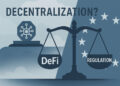


The European Union’s Markets in Crypto-Assets Regulation (MiCA) is the first broad legal framework for crypto-assets across the EU. While MiCA brings clarity to many parts of the crypto market, it leaves a critical question unresolved: how decentralized finance (DeFi) should be treated under EU law.
MiCA generally applies to crypto services with identifiable intermediaries, while fully decentralized systems remain difficult to classify under the regulation.
What MiCA Regulates
MiCA establishes harmonized rules for crypto-assets and crypto-asset service providers operating in the European Union. Its main goal is to improve consumer protection, market integrity, and legal certainty across member states.
The regulation focuses on crypto-asset issuers and service providers such as exchanges, custodians, and trading platforms. It introduces licensing, disclosure, and operational requirements designed to reduce risks for users.
MiCA does not regulate central bank digital currencies or crypto-assets already covered by existing EU financial laws. Instead, it targets areas that previously lacked consistent oversight.
How DeFi Differs From Regulated Crypto Services
Decentralized finance operates through smart contracts on public blockchains rather than through centralized companies. Users interact directly with code, often without a traditional intermediary managing funds or transactions.
This structure makes DeFi fundamentally different from regulated crypto services. In many cases, there is no single operator that can be licensed, supervised, or held legally responsible in the traditional sense.
DeFi systems are typically open, permissionless, and governed by distributed communities rather than corporate entities.
The Missing Definition of Decentralization
MiCA refers to services provided “in a fully decentralized manner without any intermediary,” stating that such services fall outside its scope. However, the regulation does not define what “fully decentralized” means in practice.
This creates uncertainty for DeFi projects that combine automated smart contracts with governance mechanisms, development teams, or upgrade controls. Even limited forms of control may raise questions about whether a protocol is truly decentralized.
As a result, similar DeFi platforms may be treated differently depending on how regulators interpret decentralization.
Why Legal Uncertainty Matters
Unclear definitions affect both developers and users. DeFi teams must decide whether their systems could be considered regulated activities, even if they are designed to minimize centralized control.
Projects that cannot confidently assess their regulatory status may restrict access for EU users or modify their architecture to reduce perceived legal risk. This can limit innovation and participation.
Institutional users face similar challenges, as regulatory uncertainty increases compliance and legal risks when interacting with DeFi protocols.
Regulatory Focus on Responsibility
EU regulators generally seek an identifiable party that can be held accountable. In DeFi, this may include developers, governance participants, or entities hosting user interfaces.
Where some level of control exists, authorities may argue that regulatory obligations apply. Fully autonomous smart contracts without ongoing human control are harder to supervise but also harder to classify.
This focus on responsibility explains why decentralization is such a critical and contested concept under MiCA.
What to Expect Going Forward
MiCA includes a review mechanism that allows EU institutions to assess whether additional rules are needed for decentralized finance. Regulators continue to study how DeFi operates and where risks may arise.
Future guidance is likely to focus on practical indicators of control, governance, and user protection rather than purely technical definitions. Until then, legal uncertainty remains a defining feature of DeFi in the EU.
For users, this means understanding that DeFi operates in a different legal environment than regulated crypto services. For projects, it means carefully balancing decentralization, usability, and regulatory risk.
Related articles
- MiCA in Spain: Crypto Platforms Face Regulatory Deadline
- BlockSec Unveils Phalcon Compliance 3.1 for Streamlined Crypto Asset KYT Screening
- US Crypto Market Structure Reform Faces Uncertainty: What It Means for Europe
- IoTeX Publishes MiCA-Compliant White Paper, Marking Regulatory Milestone
- Santiment: Crypto Market Sentiment Not Bearish Enough for a Bottom